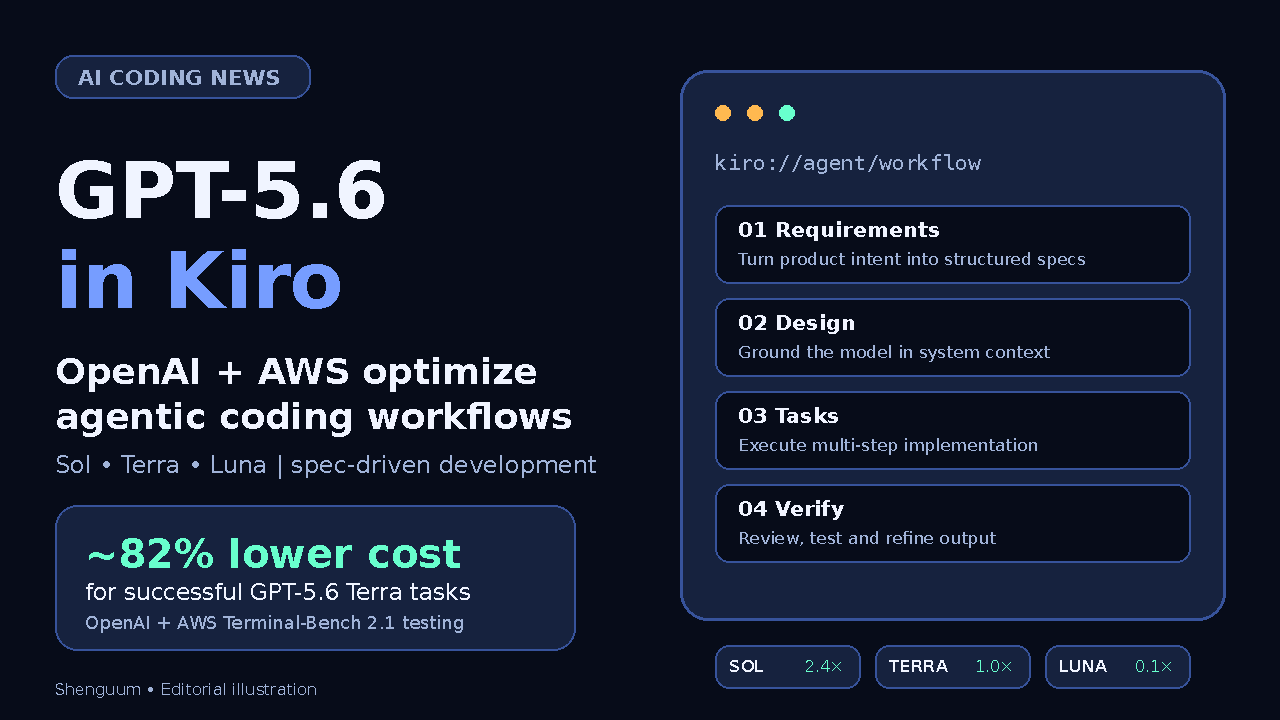
GPT-5.6 in Kiro is getting fresh attention after OpenAI and AWS published new price-performance results for AI-assisted software development. OpenAI says joint testing with AWS found that GPT-5.6 Terra completed successful Terminal-Bench 2.1 tasks in Kiro at roughly 82% lower cost in their test environment.
The important detail is that GPT-5.6 was already available in Kiro before this update. Kiro announced support for GPT-5.6 Sol, Terra and Luna in July 2026. The newer announcement is therefore best understood as an optimization and price-performance story rather than the original launch of GPT-5.6 in Kiro.
What is GPT-5.6 in Kiro?
Kiro is AWS’s agentic development environment for software engineering. Instead of treating AI coding as a simple chat-and-generate workflow, Kiro uses a more structured approach that can turn requirements into design documents, implementation tasks and code changes.
The GPT-5.6 family gives Kiro developers several OpenAI model choices for that workflow. Kiro currently documents three GPT-5.6 variants: Sol, Terra and Luna. All three are designed for coding and agentic development, but they target different balances of capability, speed and cost.
GPT-5.6 Sol, Terra and Luna in Kiro
- GPT-5.6 Sol: the highest-capability option for difficult multi-step software engineering work.
- GPT-5.6 Terra: the balanced model for strong coding performance with lower cost than Sol.
- GPT-5.6 Luna: the lowest-cost GPT-5.6 option in Kiro, aimed at faster and more economical tasks.
Kiro’s current model documentation lists a 272K context window for all three variants. The current Kiro credit multipliers are 2.4× for Sol, 1.0× for Terra and 0.1× for Luna. These multipliers matter because they affect how quickly a Kiro user’s credits are consumed when a model is selected.
OpenAI and AWS report about 82% lower cost
The headline result comes from joint OpenAI and AWS testing with GPT-5.6 Terra in Kiro. OpenAI reports that successful tasks on Terminal-Bench 2.1 were completed at roughly 82% lower cost after optimization work.
That does not mean every Kiro user will automatically reduce AI coding costs by 82%. The figure is a vendor-reported benchmark result from a specific test environment. Real-world cost will depend on the repository, prompt size, number of tool calls, task complexity and which GPT-5.6 model is selected.
Why Kiro is different from a normal AI coding assistant
Kiro is built around what AWS calls spec-driven development. A developer can begin with a product requirement, let Kiro structure that requirement into a technical design and task plan, and then use an AI model to work through the implementation.
- Requirements: define what the software should accomplish.
- Design: translate those requirements into technical decisions and architecture.
- Tasks: break the work into implementation steps.
- Verification: review, test and refine the resulting changes.
This makes Kiro relevant to the growing AI coding agent category rather than only the autocomplete-style coding assistant market. The workflow is intended to give coding agents more context and structure when working across larger software projects.
GPT-5.6 pricing changes in Kiro
Kiro also reduced the credit multipliers for Terra and Luna after OpenAI lowered model pricing. According to Kiro’s July 31 update, Terra moved from 1.2× to 1.0× and Luna dropped from 0.6× to 0.1×. Sol remains the more expensive model because it targets the hardest development tasks.
For developers, this creates a practical model-selection strategy: use Luna for inexpensive routine work, Terra when a stronger balance of reasoning and cost is needed, and Sol for the most demanding software-engineering tasks.
Is Kiro the same as Amazon Bedrock?
No. Kiro and Amazon Bedrock are separate AWS products. Kiro is a developer environment and AI coding agent workflow, while Amazon Bedrock is AWS’s managed platform for building applications with foundation models through APIs and enterprise services.
GPT-5.6 availability on Bedrock is therefore related to the wider OpenAI-AWS partnership, but it should not be confused with the GPT-5.6 experience inside Kiro.
What this means for AI coding agents
The broader story is not simply that another model has been added to another coding tool. The more significant development is the focus on price-performance. AI coding agents can consume large amounts of tokens because they read files, plan tasks, call tools, revise code and run tests over long sessions.
If model providers and developer platforms can reduce the cost of successful agentic tasks without sacrificing reliability, autonomous and semi-autonomous software development becomes easier to use on everyday projects instead of only high-value experiments.
For another example of how new AI models are being tested for coding workflows, see our coverage of the Ox Alpha AI model on OpenRouter.
Key takeaways
- GPT-5.6 Sol, Terra and Luna were already available in Kiro before the August price-performance announcement.
- OpenAI and AWS report roughly 82% lower cost for successful GPT-5.6 Terra tasks in their Terminal-Bench 2.1 testing.
- Kiro currently lists 272K context windows for Sol, Terra and Luna.
- Current Kiro credit multipliers are 2.4× for Sol, 1.0× for Terra and 0.1× for Luna.
- Kiro uses a spec-driven, agentic software-development workflow rather than functioning only as a chat-based coding assistant.
FAQ
What is Kiro AI?
Kiro is AWS’s agentic software-development environment. It uses structured specifications, technical design and implementation tasks to help AI models work through software-engineering projects.
Which GPT-5.6 models are available in Kiro?
Kiro currently documents GPT-5.6 Sol, Terra and Luna. Sol focuses on maximum capability, Terra balances capability and cost, and Luna is optimized for lower-cost usage.
Did GPT-5.6 just launch in Kiro?
No. Kiro announced GPT-5.6 support in July 2026. The newer OpenAI announcement focuses on optimization and price-performance improvements.
Does Kiro make GPT-5.6 coding 82% cheaper?
OpenAI reports roughly 82% lower cost for successful GPT-5.6 Terra tasks in a Terminal-Bench 2.1 test conducted with AWS. It is a benchmark result, not a guaranteed saving for every workload.